OFFICER SAFETY BULLETIN
The first officer sets the direction
The first officer on scene can recognize hazards, act within their training, and relay verified facts. Do not wait for rank or a specialized unit to pass on information already available to you.
Report as soon as conditions allow. Lead with immediate hazards and do not delay lifesaving action to finish the report. A quiet scene or a suspect in custody alone does not establish that the threat is over.
- Say where the problem is and where responders can safely enter. If those are different places, give both.
- Separate what you see from what dispatch or a witness reported. Say what you have not confirmed.
- Announce initial command. If command already exists, report to it.
TACTICAL REMINDER
Build the report around what responders need
Advanced Law Enforcement Rapid Response Training (ALERRT) teaches LCAN for active attack arrivals, often using Conditions and Actions. This brief adapts Location, Condition, Action, Needs to serious patrol calls as a practical option.
- Location. Give the address, road direction, entrance, floor, or landmark that will put help in the right place. Identify a safe approach or staging point when known.
- Condition. Describe the immediate threat, injuries, hazards, and uncertainty. “Residents report someone inside” is different from “I saw someone inside.”
- Action. Say what you are doing now, who has an assignment, or what you are about to do. Update the report when the task or location changes.
- Needs. Request a resource, number where known, task, destination, and urgency. “Two officers for upstream traffic control at the east approach” is more useful than “send more units.”
At a major crash, give the blocked lanes, reported injuries, possible entrapment, and the approach to keep open for EMS and fire-rescue. At a structure fire, distinguish observed smoke from unconfirmed occupancy. Request fire and EMS, and describe police evacuation support, perimeter, and traffic assignments. Coordinate access with the appropriate incident command; police coordination does not transfer fire suppression or medical authority to patrol.
Reassess police response separately
If the assessment supports reducing additional police urgency, identify the units, new response level or assignment, and the facts behind the change. Use dispatch and supervisor approval as required by agency policy. Avoid a numerical code alone when agencies may interpret it differently. Get acknowledgment of critical changes and relay them if a unit did not receive the update.
NATIONAL & TEXAS LAW-ENFORCEMENT UPDATE
What the sources establish
Texas Police Chiefs Association active attack training depicts an initial LCAN and command announcement, followed by updates. That is evidence of taught practice. The ALERRT Research Ring currently describes planned studies of report completeness, with initial data collection expected in spring 2027. The page reports no completed efficacy results for that program. Neither the slides nor the research plan establishes that LCAN reduces injuries, response times, or deaths.
DOJ's January 18, 2024 release of its review of the May 24, 2022 Robb Elementary response in Uvalde, Texas documents leadership, coordination, and communication problems. It illustrates why those functions matter. It does not establish that LCAN would have changed the outcome.
FEMA provides command transfer guidance; FHWA describes assessment, resource requests, and coordination at traffic incidents. Portland Police Bureau's directive gives an Oregon policy example: in its officer-emergency response provision, the first member able to assess tells dispatch what help is needed and when more cover is unnecessary. These are distinct sources; none creates a Texas response code or a statewide LCAN requirement.
LEADERSHIP & PROFESSIONAL CHARACTER
Make the next assignment easier
Leadership begins with useful information and a clear assignment. A supervisor can reinforce that initiative by asking what is still unknown, confirming the resource request, and helping the first officer hand off coordination without dropping a task.
A supervisor's arrival does not by itself transfer command. Follow agency procedures, brief the incoming commander on the situation, objectives, assignments, and resources en route, and announce when the transfer takes effect. An LCAN update helps start that briefing; it does not replace the complete transfer.
ROLL CALL DISCUSSION
Scenario & discussion
Fictional scenario: serious assault at a civic center
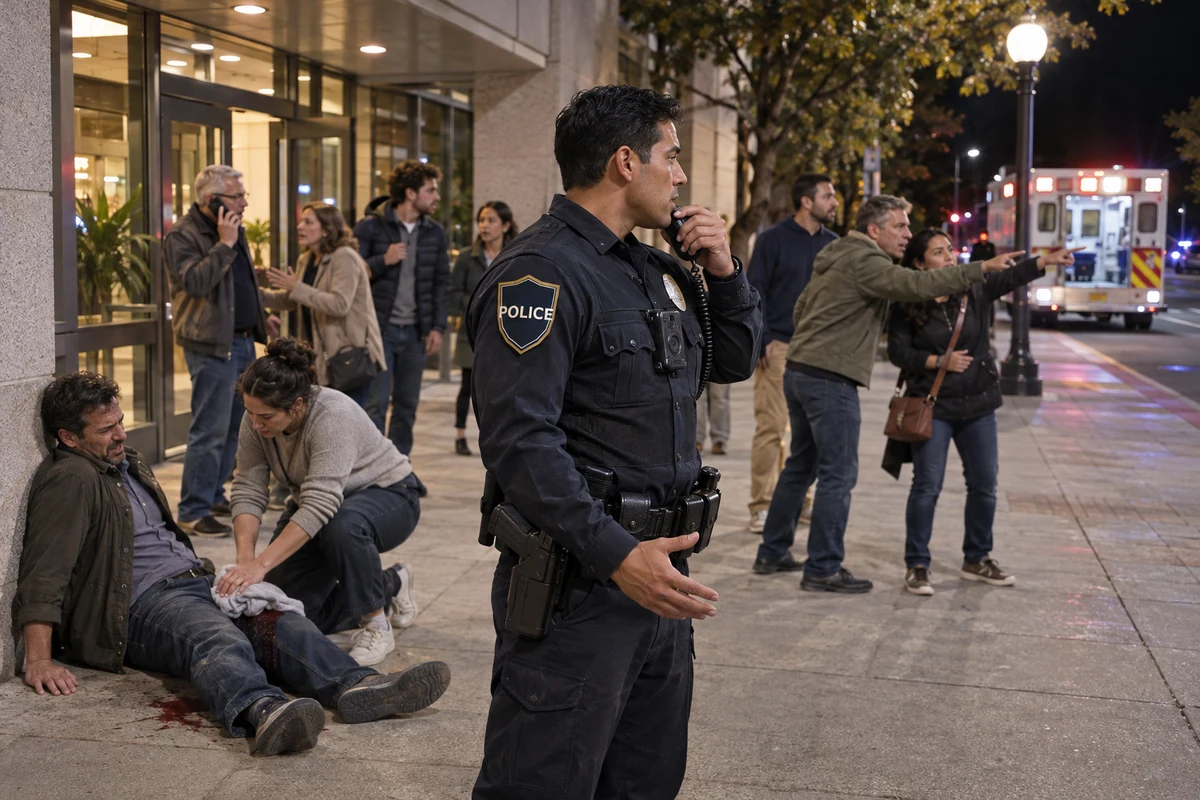
You arrive at the north entrance. One victim is bleeding heavily. Dispatch reported a knife; you have not confirmed its location or whether the suspect is in custody. Several police units are coming with lights and sirens. EMS has not arrived.
Give the initial LCAN while addressing the immediate threat and victim care within your role. Then Officer 219 reports one suspect in custody and the reported knife secured. Witnesses report no additional suspect, and your assessment identifies no continuing immediate threat requiring more emergency police units. Update Needs for specific police units under policy and keep urgent EMS coming through the north entrance. Ask dispatch to confirm the assignments. If a credible report of another armed suspect comes in, reassess promptly and state the new information, its source, and what help is needed.
- What facts support a change for specific police units, and what would make you keep or restore their emergency response?
- Which approach must stay open for EMS, and how will dispatch know the medical emergency continues?
- Who is coordinating the police response, and how will responding units know when that responsibility changes?
LEGAL WRITING & COURTROOM READINESS
Explain the facts behind the change
Record the source of key facts, the time of the update, the units affected, and the reason for the response decision. Document a dispatch acknowledgment only if it occurred. Preserve applicable radio, dispatch, and video records under policy.
Weak articulation:
"Everything was under control, so I slowed everyone down."
Stronger articulation - fictional example:
"At 19:42, Officer 219 reported one suspect in custody and the reported knife secured. My assessment identified no continuing immediate threat requiring more emergency police units. I was providing bleeding control to the victim. Under policy, I asked dispatch to have Unit 226 continue non-emergency for scene control and to hold unassigned police units. I requested urgent EMS through the north entrance. Dispatch confirmed the police assignments and relayed the access point to EMS."
THREE PRACTICAL TAKEAWAYS
- Lead from the first arrival. Assess, act within your role, and tell responding personnel what they need to know.
- Give LCAN early and update it. State location, condition, action, and needs; correct the picture when facts or assignments change.
- Make Needs specific. Identify resources, tasks, access, urgency, and any policy-consistent change for named police units. Keep medical and fire urgency separate.
"The next unit should know where to go, what to expect, and what to do."
Publication & source record
This web edition presents the briefing published on 2026-11-06. Contemporary news, legal references, and examples are retained in their original context. The complete public PDF preserves the briefing and its references.
Open the publication PDF