OFFICER SAFETY BULLETIN
The First Stopped Car Does Not Clear the Road
A stopped vehicle in the nearest lane can hide a moving vehicle in the next one. A driver may hear a siren without locating it, follow another vehicle into the intersection, or make an unexpected turn. Emergency equipment warns; it does not confirm that every driver has yielded. Read the entire conflict area before committing the patrol vehicle to it.
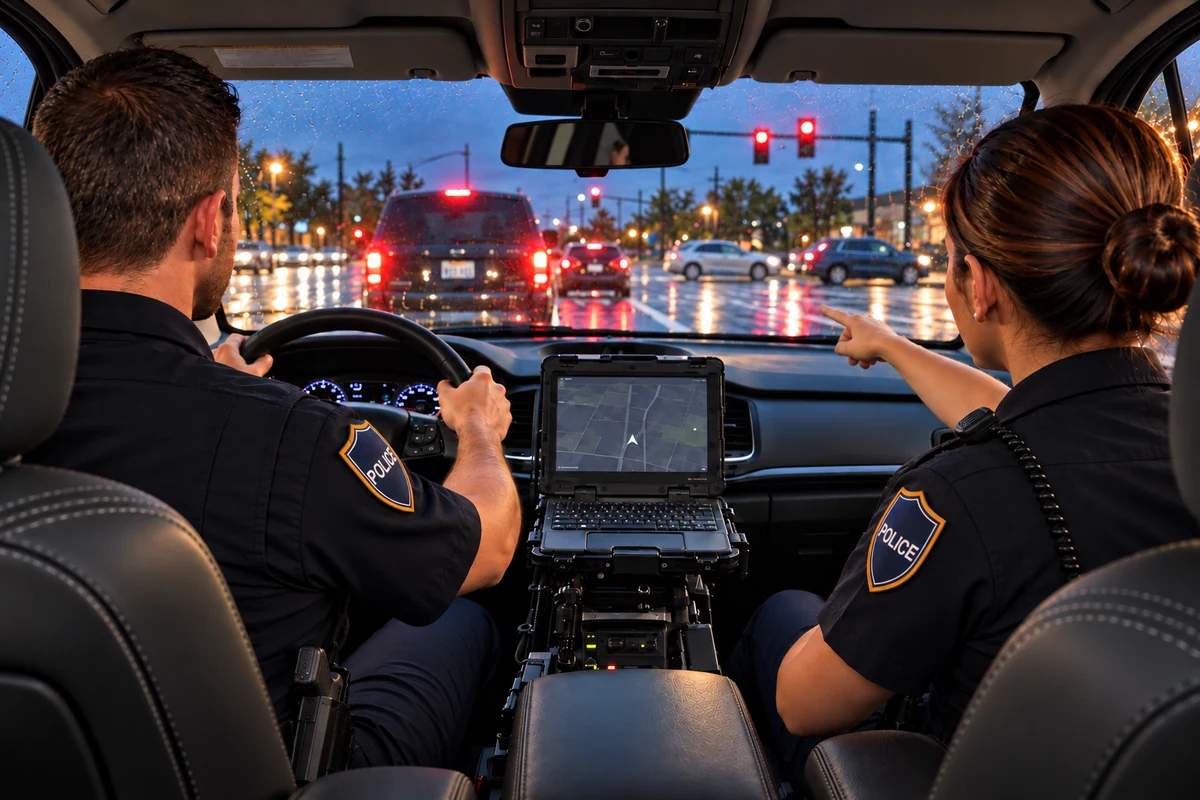
Approach early enough to brake smoothly and preserve a decision point outside crossing traffic. Read lane count, queued vehicles, turning movements, pedestrians, cyclists, roadway grade, light, weather, and available escape space. Keep attention outside the vehicle. Let a passenger handle radio or navigation when staffing and policy permit; when alone, defer nonessential tasks until safe.
Today's Officer Safety Focus
- Reduce speed before a red signal, stop sign, blind approach, or congested intersection; allow room to stop when the path cannot be assessed.
- Account for each lane and turning path. One yielded lane is evidence about that lane, not the concealed lane beside it.
- Look for people crossing from behind queued traffic and vehicles turning across the intended route.
- Reassess before accelerating out. A second conflict can develop after the first vehicle yields.
> PROFESSIONAL STANDARD: Commit only to a path you can assess and manage under the actual conditions.
TACTICAL REMINDER
Make the Decision Before the Intersection Makes It
Use a deliberate approach sequence consistent with emergency-vehicle training and department policy:
- Identify: Locate the signal, crosswalks, lane boundaries, queues, and places where another road user can emerge unseen.
- Reduce: Establish a speed that allows time to observe and respond. A full stop may be necessary; follow any stricter policy requirement.
- Verify: Check cross traffic in both directions, turning traffic, pedestrians, cyclists, and concealed lanes. Do not infer a driver's awareness from eye contact alone.
- Proceed: Move only when the path can be negotiated safely. Keep reassessing as the viewpoint changes; stop if a newly revealed conflict requires it.
- Communicate: Tell dispatch when conditions require a delay, route change, or response adjustment. A partner's warning should produce an immediate reassessment.
These are instructional recommendations, not a substitute for certified training or a claim that every intersection uses the same maneuver. Do not enter an opposing lane, mount a curb, or weave through a queue simply because the route ahead is blocked. Each proposed maneuver requires its own legal authority, policy permission, visibility, and safe path.
> REMEMBER: A siren provides warning to other drivers. Your driving must account for the possibility that no useful response occurs.
NATIONAL & TEXAS LAW-ENFORCEMENT UPDATE
Texas - Permission Has Conditions
Texas Transportation Code Section 546.001 permits an authorized emergency-vehicle operator to pass a red or stop signal or stop sign after slowing as necessary for safe operation. It permits exceeding a maximum speed limit only without endangering life or property and subject to the ordinance exception identified in the statute. Section 546.002 limits when specified privileges apply.
Section 546.003 addresses audible or visual signals under employing-department or local-government policy, subject to Section 546.004. This brief does not recommend using a signal exception. Section 546.005 preserves the duty of appropriate regard for everyone's safety and the consequences of reckless disregard. Statutory permission does not establish that a particular maneuver was safe or complied with policy.
Federal - Treat Emergency Driving as a Trained System
The U.S. Fire Administration maintains official vehicle and roadway safety resources covering emergency-vehicle operations and responder safety. This federal training resource is not Texas legal authority. Use it to support continuing training and review; apply the law and operating policy that govern your own vehicle and assignment.
No actual crash is presented as a case study in this edition. The scenario below is fictional.
LEADERSHIP & PROFESSIONAL CHARACTER
Give Your Partner Permission to Slow Down
Servant-minded leadership protects the people responding as well as the people awaiting help. A senior officer should make a timely warning easy to give and safe to receive. A passenger who says, "I cannot see the far lane," is supplying critical information. The driver should acknowledge it, reduce speed, and reassess rather than defend the original decision.
Today's leadership challenge
- Before the shift, confirm who handles navigation, radio, and intersection warnings when two officers ride together.
- Reinforce that a safe delay or route change should be communicated, not concealed to protect an arrival-time image.
- During review, ask what the driver could actually see. Coach the decision and the preparation, not an invented certainty based on the outcome.
> SERVANT-MINDED LEADERSHIP: The leader protects the team's ability to interrupt a developing hazard before it becomes a collision.
ROLL CALL DISCUSSION
Scenario & discussion
The Near Lane Has Yielded; the Far Lane Is Hidden
Fictional training scenario: At 2110 hours, two officers respond to a reported assault in progress using authorized emergency equipment. Rain has reduced visibility. Their signal is red at a four-lane cross street. A van has stopped in the nearest crossing lane, hiding the next lane. A pedestrian waits at the curb. The passenger notices headlights moving beyond the van as dispatch asks for an updated arrival time.
Discuss
- Where should the driver make the decision to slow further or stop, and what must remain visible?
- What does the stopped van establish? What does it leave unknown?
- How should the passenger communicate the hidden vehicle without creating competing instructions?
- Which radio information can wait, and who can provide the arrival update?
- What would justify resuming movement, changing route, or adjusting the response under policy?
LEGAL WRITING & COURTROOM READINESS
Describe the Conflict Paths You Actually Observed
"I cleared the intersection" is a conclusion. Explain the approach, equipment used, signal, weather, approximate speed or stop, visibility limits, road users observed, their movements, and the sequence before entry. Identify estimates as estimates and distinguish personal observations from video or information learned later. Do not claim a driver saw or heard you unless there is a factual basis.
Weak articulation:
> "I ran lights and siren, cleared traffic, and proceeded safely."
Stronger articulation - fictional example:
> "My signal was red. I stopped before the crosswalk because a van in the nearest crossing lane blocked my view of the next lane. Headlights then appeared beyond the van and a sedan crossed in front of us. After the sedan passed, I could see both crossing lanes to my left and the approaching lanes to my right. I checked the pedestrian at the curb and resumed at low speed while continuing to scan."
Use only facts true of the actual response. Preserve required vehicle recordings, CAD information, and supplements under policy. An absence of collision does not by itself establish that every decision was reasonable.
THREE PRACTICAL TAKEAWAYS
- Reduce before commitment. Match approach speed to what can be seen and managed; stop when necessary or required by policy.
- Account for every conflict path. A yielded lane, activated siren, or favorable signal does not clear concealed traffic or pedestrians.
- Communicate and explain. Invite a partner's warning, report necessary adjustments, and document observations instead of a blanket claim that traffic was clear.
> "The response succeeds when you reach the person who needs help without creating another person who does."
Publication & source record
This web edition presents the briefing published on 2026-10-30. Contemporary news, legal references, and examples are retained in their original context. The complete public PDF preserves the briefing and its references.
Open the publication PDF