From the Editor
September’s four Roll Call Briefs moved through different patrol problems—impaired-driving enforcement, warrant apprehension, public recording and interference, and evidence control—but they kept returning to one professional habit: make the decision trail visible.
A lawful result is stronger when another reader can reconstruct the path to it. What did the officer observe? What authority supported the next step? What purpose did that step serve? What changed, who handled it, and how was it preserved? Those questions belong in the field, not only at the keyboard. When officers answer them in real time, reports become more accurate, partners coordinate more cleanly, and later reviewers have less need to guess.
The Month’s Standard
The month began with impaired-driving enforcement and the reminder to observe before labeling. “Intoxicated,” “unsafe,” and “impaired” are conclusions. The usable record is built from concrete facts: lane position, speed changes, braking, response to emergency equipment, speech, balance, divided attention, admissions, test instructions, test performance, time, location, and sequence. The September 4 brief, Observe. Sequence. Support., emphasized that chronology is not decoration. It is what lets a reader understand how the investigation developed.
The September 11 brief, Verify. Coordinate. Articulate., applied the same discipline to warrant apprehension. Before movement, verify the warrant, the person, and the place. Then assign containment, contact, arrest, prisoner control, and documentation roles. Most important, do not blend separate legal authorities. Authority to enter, arrest, search the person, conduct a protective sweep, or search for evidence may come from different facts and different rules. A clear report identifies each action and its own basis.
On September 18, Distinguish. Direct. Document. addressed public recording and interference. The professional task is to distinguish protected observation and criticism from conduct that materially disrupts a duty. When a boundary is necessary, state it in conduct-based terms: where the person must stand, what movement must stop, or what safety space must remain open. Then document the duty underway, the specific conduct, its actual effect, the direction given, the opportunity to comply, and what happened next.
The final brief, Protect. Preserve. Prove., completed the sequence. Control immediate hazards first. Preserve original condition and location when safety permits. Document unavoidable movement. Limit handling, package correctly, and make custody changes traceable. The courtroom foundation begins with personal knowledge and authentication: who saw the item, how it was recognized, what changed, and why the offered evidence is what the witness says it is.
Together, the briefs establish a single operational standard: slow the transition points. The moment an observation becomes detention, detention becomes arrest, a bystander becomes an obstruction concern, or a dangerous object becomes evidence is where assumptions can enter the record. Name the transition, explain the reason, and preserve the sequence.
Three Lessons Worth Keeping
1. Facts should arrive before labels.
Write the sensory and chronological facts that support the conclusion. A label may summarize; it cannot substitute for the observations that make the conclusion credible.
2. Separate authority, purpose, and scope.
One lawful action does not automatically authorize the next. State what officers were doing, why they were permitted to do it, and what limited the action. This is as important during a warrant service as it is when directing a bystander or moving evidence for safety.
3. Preserve the handoff.
Every transfer—between officers, locations, containers, units, or stages of an investigation—creates a potential gap. Say who assumed responsibility, what was communicated, what condition existed at transfer, and where the item or person went next.
Texas and Federal Professional Watch
Texas: patrol documentation remains the first forensic record
On September 21, the Texas Department of Public Safety reported that its 16 accredited laboratories and forensic-science program processed 113,259 requests during the prior year across disciplines including DNA, firearms and toolmarks, digital evidence, toxicology, and seized drugs. The scale matters, but the patrol lesson is local: laboratory work cannot recreate an item’s original location, condition, packaging, or first transfer if the scene record never captured them.
The current Texas Rules of Evidence, effective July 2, 2026, retain the core foundations in Rules 602 and 901: testimony generally rests on personal knowledge, and evidence must be supported well enough to show that it is what the proponent claims. Officers strengthen those foundations by identifying what they personally observed and by documenting recognition, condition, handling, and custody without adopting another person’s observations as their own.
Federal: later connections depend on the first recovery
On September 24, the Bureau of Alcohol, Tobacco, Firearms and Explosives described a case in which ballistic testing connected a firearm recovered after a later vehicle pursuit to cartridge cases from a 2025 homicide. The operational lesson is not the technology alone. A later comparison remains useful because the firearm and cartridge cases were recognized, recovered, documented, and preserved in a way that allowed separate events to be connected.
The FBI’s September 14 summary of a multiagency Louisiana initiative reported 662 arrests on more than 1,000 charges during the June 1–August 31 operation. Those are agency-reported arrest and charge figures, not convictions. For working officers, the enduring point is coordination: large operations depend on accurate identifiers, clear role assignments, evidence accountability, and reports that remain understandable outside the originating unit.
The Briefing-Room Scenario
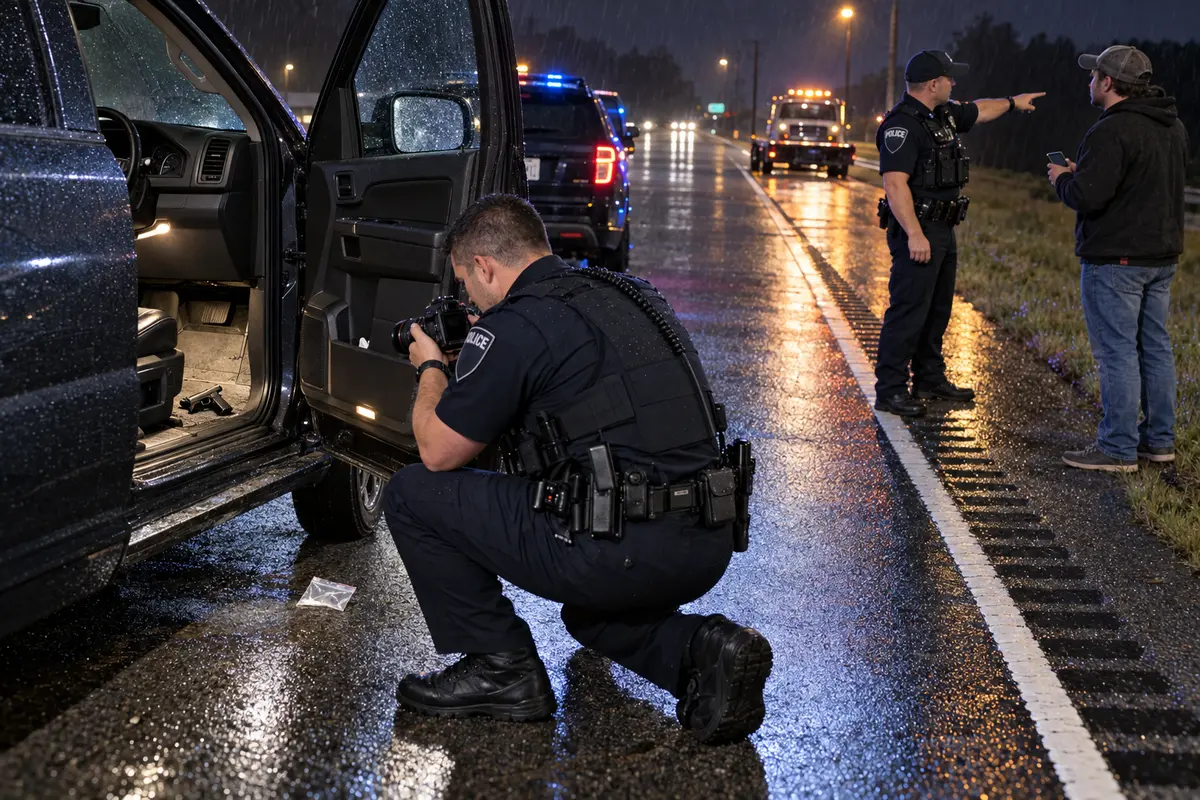
At 2345 hours, an officer stops a pickup after observing repeated lane departures and delayed braking. The driver shows several signs consistent with impairment. Dispatch then confirms an active felony warrant. While backup handles the arrest, a bystander records from the shoulder and steps into the working area despite traffic still passing. During the driver’s exit, an officer sees a handgun on the floorboard and a small bag fall beside the seat. Rain is beginning, and a tow operator has arrived.
Discuss
- What observations, times, and sequence should be preserved before conclusions are written?
- Who should own traffic safety, prisoner control, the bystander boundary, evidence documentation, and the tow handoff?
- What distinct authority supports each detention, arrest, safety action, and search? What remains unresolved?
- What direction to the bystander would be specific, safety-based, and no broader than necessary?
- If an item must be moved immediately, how should its original condition, reason for movement, handling, packaging, and custody be documented?
Leadership in Practice
Servant-minded leadership makes disciplined work easier for the next officer. On a crowded scene, the experienced officer does not merely point out omissions after the fact. The officer clarifies roles, names what is known and unknown, protects the partner’s opportunity to make independent observations, and explains why a boundary or evidence step matters. During review, begin with the decision trail before correcting grammar: What fact led to this action? What authority applied? What changed? Who carried the responsibility next? That approach protects the officer, the case, and the public without turning coaching into humiliation.
From the Library
September’s Roll Call Briefs remain available free:
Next Month
October will examine how working officers and first-line leaders correct small drift before it becomes the shift standard. The central question: How do we make timely correction practical, respectful, and durable? The focus will remain field-ready—preparation, role clarity, peer intervention, report review, and after-action learning.
Publication & source record
The Patrol Review is independent professional-development material. Officers should follow current law, controlling court decisions, and their agency’s policies and procedures.
Open the publication PDF